Birding Trip to Costa Rica, May
28 – June 4, 2009
(With a few comments on astronomy)
First I will discuss our traveling philosophy, the fact that
we went in the off-season, and the fact that this was a rather short, focused
trip. I hope our experiences will
be of interest to other like-minded birders who have "reached a certain age."
Costa Rica is a place I always wanted to bird, and this
seemed like the time. My wife and I went.
I am an experienced birder. She is a semi-birder. Neither of us had
ever been to Costa Rica. I had never been to the true tropics, though I have
birded some in Hawaii, Puerto Rico, and Yucatan. We are experienced travelers.
We did not want to join any kind of tour. We decided to drive ourselves, as we
have done many times in North America, Puerto Rico, and Europe. We wanted to see some sights, such as
the Arenal volcano, and visit the coast. We wanted to minimize our time in San
Jose, and in all cities.
Being one's own bird guide in a really new place is a
challenge some people do not like.
I do.
The drawback is not recognizing any songs at first, and having to flip
through the field guide a lot. It
helps to have a good field guide (more on that later). But I think the challenge leads to
deeper learning (just as I always tell my students). The flip side is the virtual certainty that your final list
is not going to be as large. For
me, that's no problem. I made no
attempt to maximize the list, and I did not go out of my way to chase any
species. I made no attempt at all
to find water birds. We did not
visit the northeastern third of the country, nor the northwestern corner, nor
the extreme south.
We had only seven actual birding days. If you search the web for other Costa
Rica reports, you will find they usually spend at least nine days, and usually
fourteen, birding. Since we
weren't going to be speeding around like lunatics, we had a restricted
itinerary. We spent two days at
Arenal, two at Dominical (Pacific Coast), two at Savegre Mountain Hotel, and
one traveling. This yields an
appealing loop from San Jose.
Probably everyone knows this but I'll say it anyway: the roads in Costa Rica are substandard by North American standards.
Make your best estimate of how long a trip will take and double it.
Prices drop as the wet season begins, and so did
airfares. There is plenty of room at hotels and restaurants.
The wet season was
really no problem. The mornings are
clear, sunny, and delightful. It starts to cloud up by 11:00 and usually rains
by 1:00. It rains off and on until
5:00 or 6:00, and the evenings are usually cloudy. Sometime overnight it clears again. (One exception to this will be
discussed below.) The afternoon
rains were never a problem to us, and it always seemed to be possible to do
some birding in the afternoon. I have read that
later on, after August, it rains all the time.
Probably because we came in late May and early June, I
saw absolutely no North American winterers or migrants.
The actual trip:
We arrived at the airport the night of May 27. It was
raining. We were picked up by
Steve, our gracious host at Casa Bella Rita. He drove us to the wonderful Casa Bella Rita (CBR). Our room was very good, except we
didn't notice until all was dark and we were getting into bed that there was no
real blanket! We made do with
bathrobes and the funny little half blanket that was there.
The next morning was mostly clear and sunny. I loved the
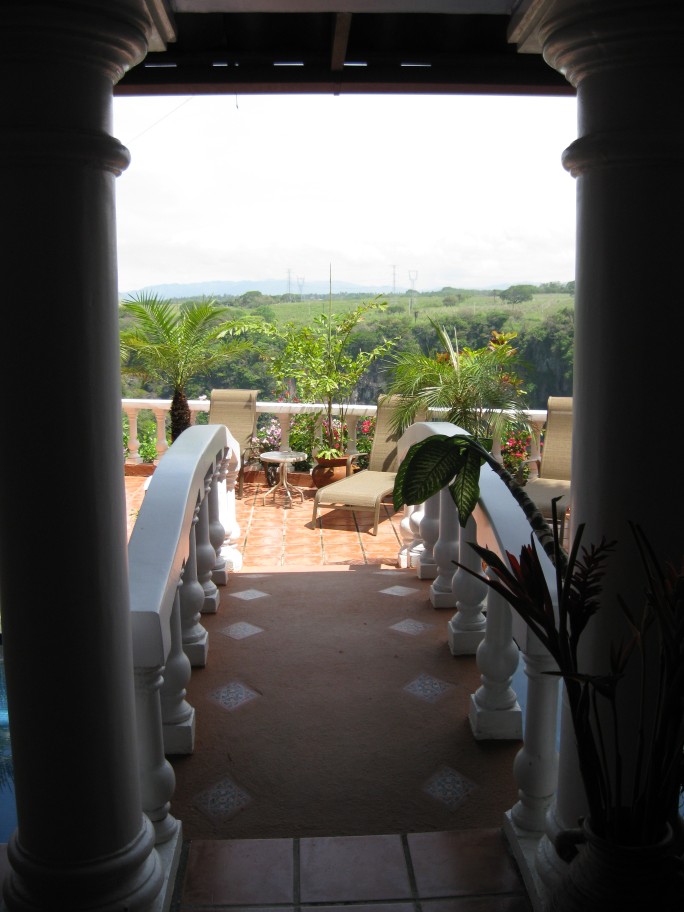
patio overlooking a gorge and quickly racked up the lifers.
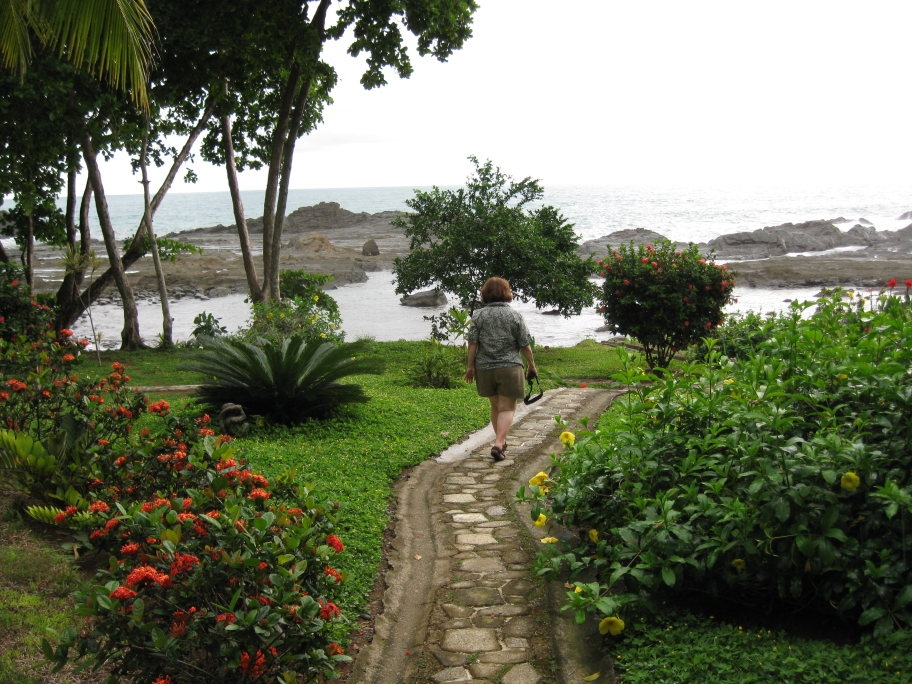
Walkway over Pool to Patio at CBR.
Note on the lists: lifers are marked by *. Commonly occurring birds are not
necessarily listed at every location where we saw them. For example, Clay-colored Robin was
virtually everywhere. Besides
vultures of course, only three other species deserve to be called abundant, Great-tailed
Grackle, Tropical Kingbird, and Rufous-collared Sparrow.
Birds at CBR:
Turkey Vulture
Black Vulture
Clay-colored Robin
Grayish Saltator*
Rufous-naped Wren*
Montezuma Oropendola*
Blue-and-white Swallow*
Grey-breasted Martin*
White-winged Dove
Crimson-fronted Parakeet*
White-collared Swift*
Vaux's Swift
Social Flycatcher*
Tropical Kingbird
Brown Jay
Great-tailed Grackle
Eastern Meadowlark (airport
runway)
We returned to spend the night of June 3. On the morning of
June 4 I saw flying:
Masked Tityra*
Steve drove us into San Jose where we rented a
four-wheel drive vehicle from Wild Rider.
I STRONGY recommend renting a four-wheel drive car. Get the smallest you
can put up with, because of the narrow winding mountain roads; a wide SUV is
going to have trouble, especially if another vehicle comes. We did not have a GPS, and didn't miss
it. (Of course, at home we don't use one.
Not to insult anyone, but if you need a GPS in most of the US you must
be cartographically challenged.)
We made our way out of town (with some confusion) and got on the road to
San Ramon and eventually to the Arenal volcano area. Along the way the narrow windy road was blocked by a washout
for a while.
We arrived finally at the very lovely Lomas del Vulcan
(LDV). This is a beautiful newish resort.
Our "cabin" was excellent, with two beds, air conditioning,
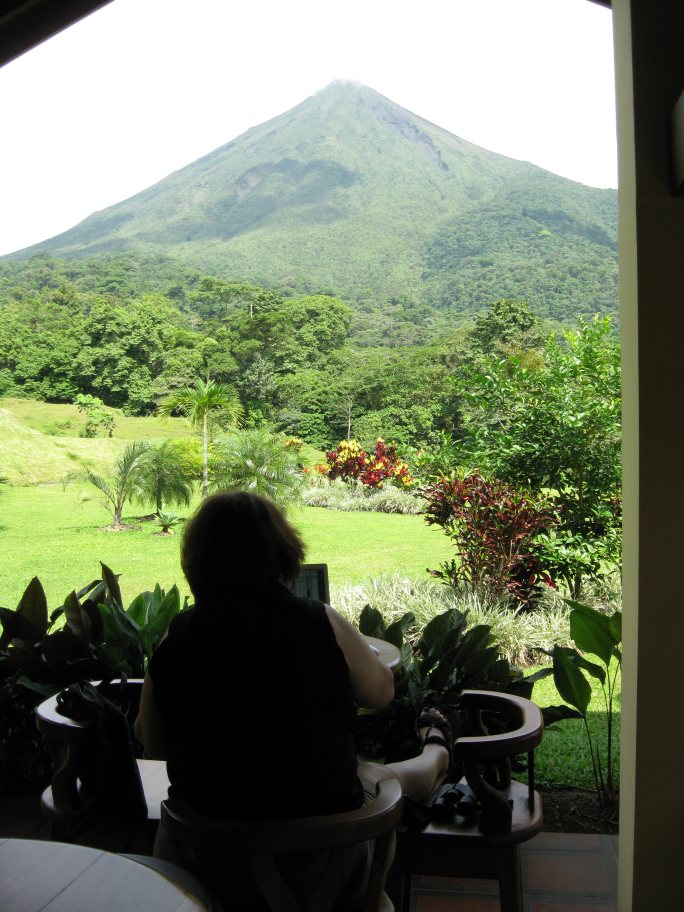
refrigerator, and a huge bathroom, with a great shower. It had a patio with a good view of the
volcano that also provided good views of the neighboring area for lifers! We awoke the first morning to hear a
loud lion-like roaring. Turned out
it was a howler monkey! We assumed
we would soon see lots of them, but that was the one and only such occurrence
for the entire trip. We never saw
any monkeys.
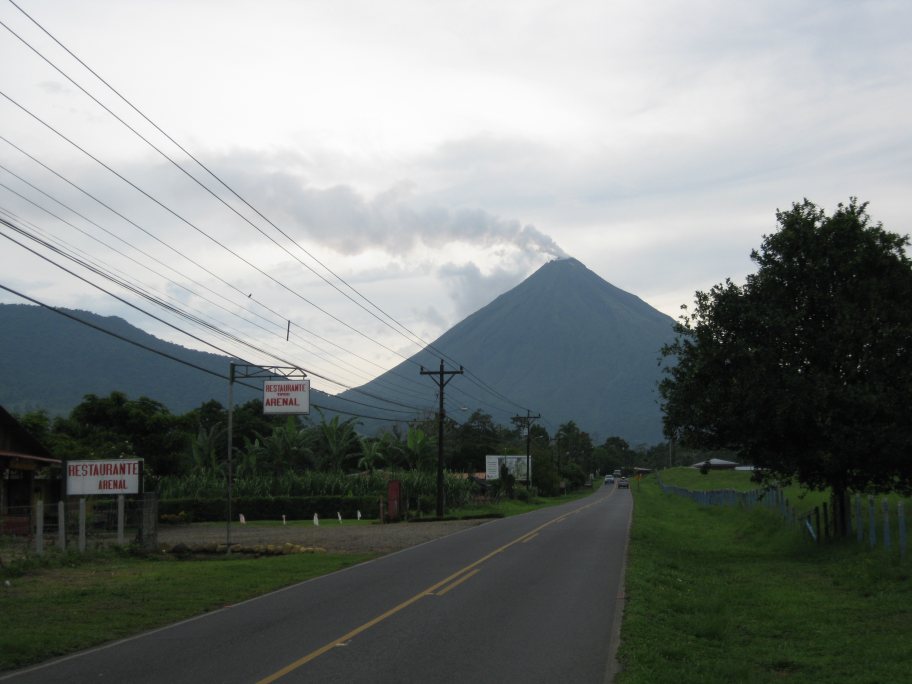
Approaching La Fortuna from the east.
The hotel is situated on its own many-acre campus on
the eastern slope of Arenal. Wifi
is available at the main building. Birding on the grounds is easy and
productive. The entrance driveway is maybe a kilometer west of La Fortuna, and
it's another kilometer from there up to the hotel. People do walk from the hotel to La Fortuna, but of course
we had a car and had no reason to go into La Fortuna anyway. The food at the hotel was excellent!
On the 29th we drove to Arenal Hanging Bridges in
the afternoon. This place is OK but not really worth the money. Birding was poor; maybe it would be
better in the morning. However, on the way we came upon two stopped cars.
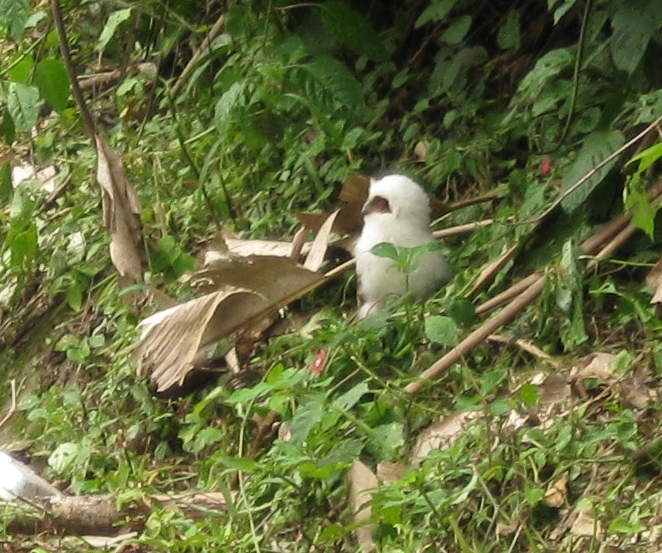
People had gotten out and were looking at something just off the road. It was a
fledgling owl! I took photos and
looked it up later, a Spectacled Owl.
At the hanging bridges I was lucky to find a Sulphur-rumped Flycatcher.
Birds at LDV:
Red-billed Pigeon
Band-tailed Pigeon
Short-billed Pigeon*
Ruddy Ground-Dove*
White-tipped Dove
Orange-chinned Parakeet*
Red-lored Parrot*
Grove-billed Ani
Swallow-tailed Kite
Gray Hawk
Rufous-tailed Hummingbird*
Chestnut-mandibled Toucan*
Black-cheeked Woodpecker*
Northern Beardless-Tyrannulet
Common Tody-Flycatcher* (one of my favorite birds for the trip)
Great Kiskadee
Tropical Kingbird
Northern Rough-winged Swallow
Band-backed Wren* (one of my favorite birds for the trip)
House Wren (common)
Buff-rumped Warbler* (one of my
favorite birds for the trip)
Black-and-yellow Tanager*
Passerini's Tanager* (common)
Blue-gray Tanager*
Palm Tanager*
Thick-billed Seed-Finch*
Variable Seedeater*
White-collared Seedeater
Yellow-faced Grassquit*
Blue-black Grassquit* (cute)
Rufous-collared Sparrow*
Melodious Blackbird* (should be
called screaming blackbird)
Not at LDV but nearby:
Spectacled Owl*
Sulphur-rumped Flycatcher*
Red-winged Blackbird
On May 30 we drove from LDV to Dominical. This is a
loonnnnggg drive, from the Arenal area through San Ramon all the way down the
Pacific coast to Dominical. The last 40 kms after Quepos is over a terrible
gravel road, which at least is being paved. We did not stop at Manuel Antonia. On the coastal drive I
saw
Brown Pelican
Magnificent Frigatebird
Great Egret
Cattle Egret
Yellow-headed Caracara*
Laughing Falcon*
Rock Dove
Great-tailed Grackle
We arrived at Costa Paraiso (CP), a very well situated
lovely place. Our room was quite
nice, with two beds, refrigerator, kitchen, air conditioning (VERY necessary),
and wifi that sometimes was a bit weak (but was always strong at the main building). The manager told us they often see an
owl at night next to their bright floodlight! On the night of the 31st we saw it! Lovely, very close, perched in a palm
tree waiting to catch a bat, a Black-and-White Owl. Also that night I heard a call that perfectly matched the
description of Striped Owl.
You don't see these at Jones Beach.
Earlier that day we drove south as far as Playa Tortuga,
where I saw Amazon Kingfisher, Mangrove Swallow, Grey-breasted Martin, and a
flock of five or six Collared Plovers.
It was neat to see some mangroves. We took a little dirt road off the
highway and got to a beach in only a hundred meters. This area can be seen on
the map half way between Pinuela and Cortes. The inlet to the ocean was to our
north, with a peninsula visible to the west.
Birds at CP and south:
Green Heron
Collared Plover*
Black-and-white Owl*
Crested Guan*
Smooth-billed Ani
Rufous-tailed Hummingbird
Amazon Kingfisher*
Red-crowned Woodpecker*
Piratic Flycatcher*
Tropical Kingbird
Scrub Greenlet*
Mangrove Swallow*
Grey-breasted Martin
Bananaquit
Cherrie's Tanager*
Red-legged Honeycreeper*
That evening we drove into Dominical. Don't miss driving out
to the beach here where the river meets the ocean.
Neotropical Cormorant
Brown Pelican
Magnificent Frigatebird
Brown Booby
Cattle Egret
Laughing Gull
Royal Tern
Old friend from North America on the beach at Dominical. (No I don't mean the men.)
On June 1 we left CP to drive to the Savegre Mountain Hotel
(SV). Please read about the
history of this wonderful place; I will not repeat it here. The directions you find on their
website are pretty good. Also note that the road off the main highway is shown
on the large Costa Rica road map; it goes south to San Gerardo de Dota. This
windy narrow mountain road is dirt some places, but not dangerous, at least for
four wheeled drive vehicles. Near
the beginning of the road, Sooty Robin is common. Over the nine kilometer
stretch to the hotel, you drop quite a bit, maybe 800 feet.
The hotel is wonderful. Our new roomy modern "cabin" had two beds, an excellent
bathroom, and a portable space heater – no air conditioner here! –
which comes in handy in the morning.
The grounds are wonderfully maintained. The food is good (not as good as
LDV); choose the trout (which is VERY local) over the beef and pork. There is a
computer with internet, but the internet was down (bummer).
The hotel is at 7200 feet altitude. This is the highest altitude I have
ever slept at, and I noticed it a bit.
No problem, but something to consider. I also felt it hiking around.
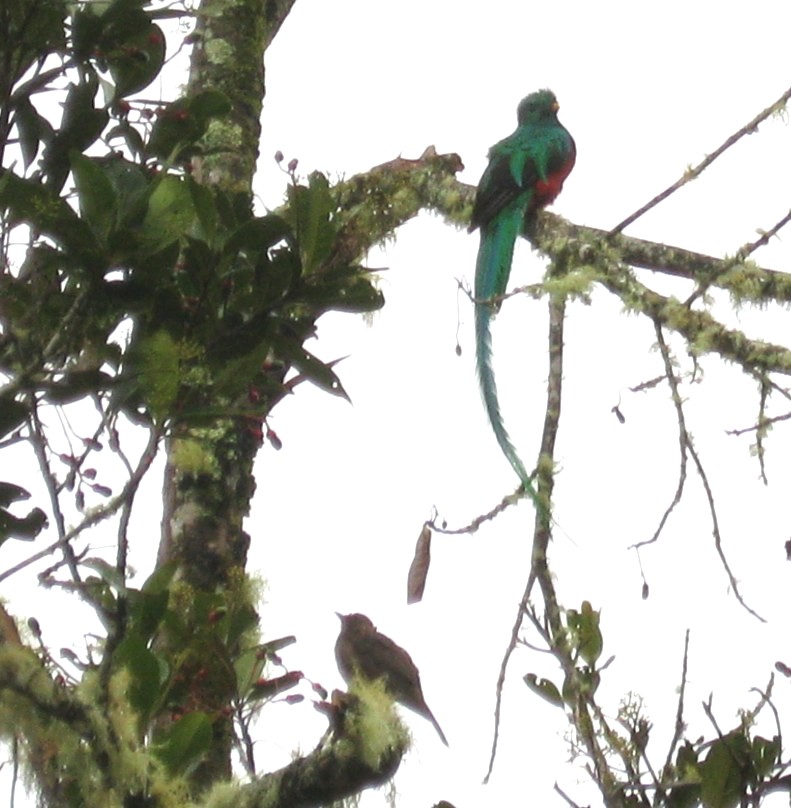
This place is famous for Resplendent Quetzel, and we had no
trouble. A male came often to the
fruit trees near cabin 115.
Mandatory Quetzal shot. (BTW, the other bird in the photo is just what you would guess if you went by probabilities.)
As you will see from their website, there is a network of
higher trails to the south of the hotel that one can drive up to with
four-wheeled drive. True, you could just hike up, but I for one would not be
able to do so at this altitude. I
did not walk the highest trail. Of the other two, the middle level one is
through an interesting, more open forest. The lowest one starts out in a dense
forest, then breaks into the open for a while. BEWARE the barbed wire fence here! It is easy to overlook. We drove to the upper end of the road
and I walked a bit downhill. This
is where I had Black Guan and my first Collared Redstart.
But even more interesting than those trails is the trail
that starts near the dining room, near room 120, and goes basically parallel to
the road, into the grounds of the next resort or hotel. This is where I had Buff-fronted
Quail-Dove, Large-footed Finch, Dark Pewee, Yellowish Flycatcher, Olive-striped
Flycatcher, Dipper, and more.
Magnificent Hummingbird, a.k.a. the tyrant of the feeders.
Birds at Savegre:
Black Guan*
Buff-fronted Quail-Dove* (gorgeous)
Swallow-tailed Kite
Red-tailed Hawk
Sulfur-winged Parakeet*
Barred Parakeet*
[Costa-Rican Pygmy Owl. heard]
Violet Sabrewing*
Fiery-throated Hummingbird*
Magnificent Hummingbird
Green Violet-ear*
White-throated Mountain-gem*
Scintillant Hummingbird*
Volcano Hummingbird*
Resplendant Quetzel*
Emerald Toucanet*
Acorn Woodpecker
Spot-crowned Woodcreeper*
Yellow-bellied Elaenia*
Mountain Elaenia*
Olive-striped Flycatcher*
Dark Pewee*
Yellowish Flycatcher*
Tropical Kingbird
Barred Becard*
Yellow-winged Vireo*
Gray-breasted Wood-Wren*
Ruddy-capped
Nightingale-Thrush* (common)
Sooty Robin*
Clay-colored Robin
American Dipper
Long-tailed Silky-Flycatcher*
Black-and-yellow
Silky-Flycatcher*
Collared Redstart*
Black-cheeked Warbler*
Common Bush-Tanager*
Sooty-capped Bush-Tanager*
Flame-colored Tanager*
Yellow-faced Grassquit
Slaty Flowerpiercer*
Large-footed Finch* (acts like
a Towhee)
Yellow-thighed Finch* (pretty
common)
Rufous-collared Sparrow
Melodious Blackbird
76 lifers. Two probables not counted.
Field Guide critique:
Before I left, I ordered two field guides, the classic
Stiles and Skutch, and the new one by Garrigues. Stiles and Skutch did not come
in time, so I had only Garrigues.
This guide has a very appealing format, with text and images facing each
other. I liked it a lot. The only drawback is that several of the paintings are
poor, to the point where I would have missed several identifications. Fortunately, I could search the
internet and download photos.
Specifically,
Buff-fronted Quail-Dove: should
be a beautiful gray-blue all over the nape and
breast.
Red-billed Pigeon: this
painting is ridiculous. Google a
photo and see.
White-tipped Dove should be
grayer underneath.
Gray Hawk adult: the jizz is
wrong, tail should be longer.
Violet Sabrewing: bill should
be longer, more decurved.
Magnificent Hummingbird (male):
jizz is wrong, bird usually does not show
those colors.
Ruddy-capped
Nightingale-Thrush: cap should not be so well defined.
Underparts are grayer. Coloration is more subtle than
pictured here.
Common Tody-Flycatcher: the
wings should be blacker and the jizz is more like
a Gnatcatcher.
Long-tailed Silky-Flycatcher:
some have virtually no yellow, all gray.
Palm Tanager: folded wings
should show a more obvious "dipped in ink"
effect. The head has a delicate yellow wash.
Lincoln's Sparrow: it's rare in
Costa Rica, but still, this is a terrible painting.
Red-winged Blackbird: the
female is too neat and prissy.
But really, this is a fine field guide, and having now seen the Stiles-Skutch, I am glad that I had the Garrigues.
Astronomy Note:
Like the vast majority of the human population, I live much too far
north to ever see one of the brightest and most renowned stars, Alpha
Centauri. This star is famous as
being the closest to our solar system, and is mentioned in many classic science
fiction tales. As a long time
amateur astronomer, I realized a few weeks earlier that Costa Rica is far
enough south to see Alpha Centauri. This is by far the farthest south I have
ever been, latitude 9. By the star charts, that should be far enough, but not
by much. By a stroke of luck, this is exactly the time of year when it
appears above the horizon at the best time, around 8:30 - 9:30 pm.
But it is also the rainy season. Every
night was cloudy until the sixth night. We were in the wonderful Savegre
mountain locale, but that means lots of surrounding hills. Nonetheless,
it was perfect. It's quite a sight. Alpha Centauri is the third brightest
star. Number 4, Vega, and number 5, Arcturus, were also visible.
But more than that, very close to its right is Beta Centauri, also in the
top twenty, and just to the right is the southern cross, containing three
bright stars, including Alpha and Beta Crucis, also in the top twenty.
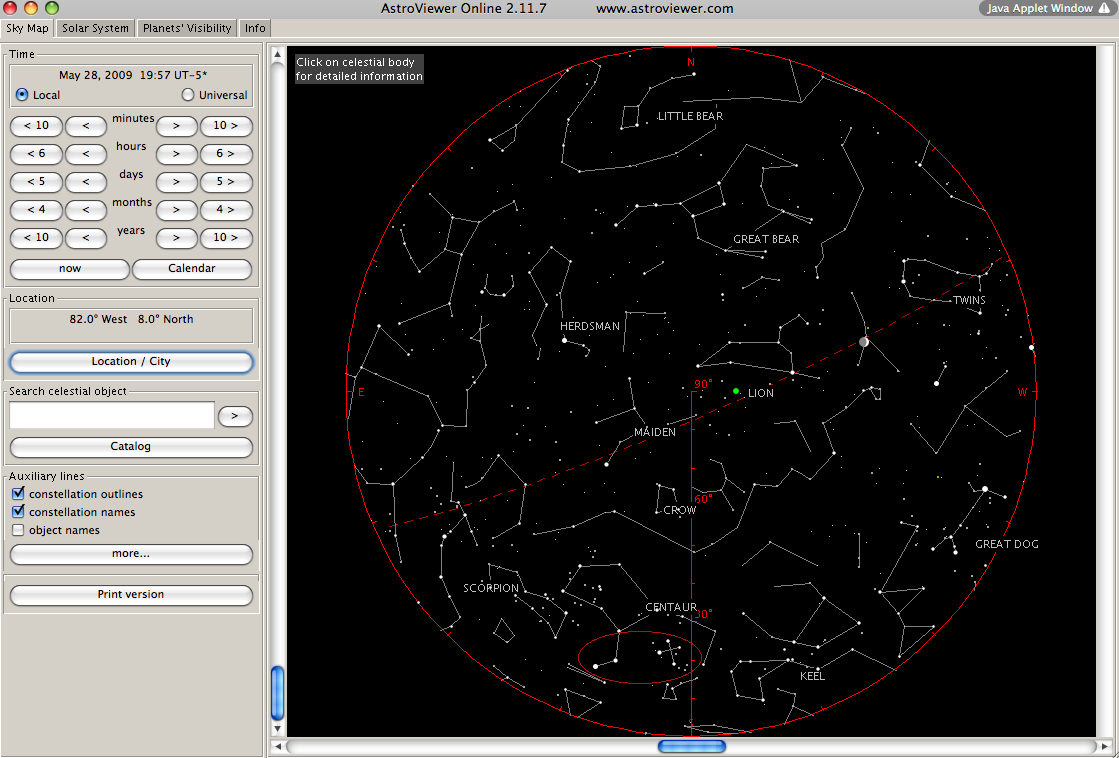
You could Google all this to see what I mean, or click the link below, where I have circled the area in red. A marvelous experience, as was the whole trip.
Night sky at Savegre, about 9:00pm.
Businesses Mentioned Above:
Robert H. Lewis
New York City suburbs
rfermat@yahoo.com