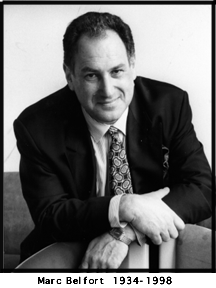
Marc Belfort, who was the director of the International Opera Center at the Zurich Opera for the past 24 years, died in Zurich on March 4th, 1998, after a long struggle with cancer. A native of New York, Marc studied singing and philosophy at Columbia University, and sang professionally as a cantor in New York City. He appeared as an operatic baritone in Europe, South America and the U.S, in addition to being entertainment chief for the U.S. Army in Europe and an artist manager/impresario in Germany. Recognized by the European operatic community as a master teacher and connoisseur of operatic talent, he was a 1991 recipient of Switzerland's coveted Doron Prize for his contribution to culture. Besides his services as coach, teacher, administrator and over-all mentor promoting his student artists to agents and theater directors, Marc was an accomplished stage director who presented many critically acclaimed studio productions in Zurich.
Besides being responsible for the day-to-day operation of the studio, organizing concerts and seeking financial support for the students, Marc was active in the main house. During the theater's remodeling season, he was director of production for Aida and West Side Story in performances at alternative venues. Zurich Opera's current General Director, Alexander Pereira, describes Marc's work on the last Zurich Festival's production of Elisir d'amore as "characteristically spontaneous, charming, loving, humanistic and professional." The opera company's artistic personnel, who regularly chose Marc as their representative, valued his abilities as a caring mediator and a patient, tenacious negotiator. He was the embodiment of truth and ethics, and his unerring sense of artistry and style earned him the highest respect of the community inside, as well as outside the opera house. He inspired devotion and trust and his opinion about various operatic topics, such as which roles are appropriate for which singers and how to interpret a new role, were sought and valued not only by his current or former students, but by established artists from all over the world. His tireless enthusiasm and cheerful energy helped many young talents realize their full potential.
The Zurich Opera Studio was founded by Herbert Graf in 1961. After becoming director in 1974, Marc expanded this training center for young opera singers into a world renowned institution known popularly as a Talentschmiede (forge of talent) with himself dubbed Sängervater (father/mentor of singers) by the media. Many international careers were launched under his guidance. His love of music and theater coupled with his passion for nurturing young talent gave him the strength to transmit this energy to his students. With his wife, the popular leading soprano of the Zurich Opera, Renate Lehnhart, he often held workshops and participated in festivals around the world. He not only developed singers, but many coaches/conductors and stage directors were molded by his operatic vision.
 In an Opera News article of October 1993, Marc Belfort discussed his philosophy of teaching: "A singer needs great survival instincts! A good technique is important and natural beauty of voice is important. An individual sound is important. There is also personality involved - charisma, the ability to communicate emotion and atmosphere. A singer has to have a gymnastic intelligence - a feeling for the way his or her body responds as a singing instrument. Developing a singer's curiosity and ability to associate are things that I use in my work. I'm surprised at the beginning of the year how low-key this imaginative process is in young people - and then equally surprised at how quickly it can be fired up. It's not a question of being absent - it has just never been tapped. Once you start to talk about possible relationships in an opera - possible psychological relationships - in terms of cultural history, it makes it vivid on stage for them. Those things, in the end, are the most important part of teaching. It has to be done. People don't come to us with that knowledge. Above all, I believe in letting each singer become the best who they are possible. I don't try to change a singer into what (s)he is not. I try to make him more what (s)he is and thereby allow him to achieve success on his own terms."
Marc never thought of himself as a star maker. Whether or not a person was going to receive international adulation interested him not at all. He always emphasized that so many good singers are needed, over and above the handful of so-called stars, that an artist can have an enormously active and satisfying career, contributing a great deal to the opera world, without being encumbered by the idea of becoming a star. The most telling measure of his success is that there is hardly a single theater in Germany, Austria or Switzerland that doesn't have a member of the International Opera Center on its roster.
Marc's passing is a painful loss not only to the hundreds of artists that had come to know, trust and love him, but to the young operatic talent that will never have the chance to be influenced and inspired by him. He was an honest and loyal friend.
To return to IOC Information click here: 